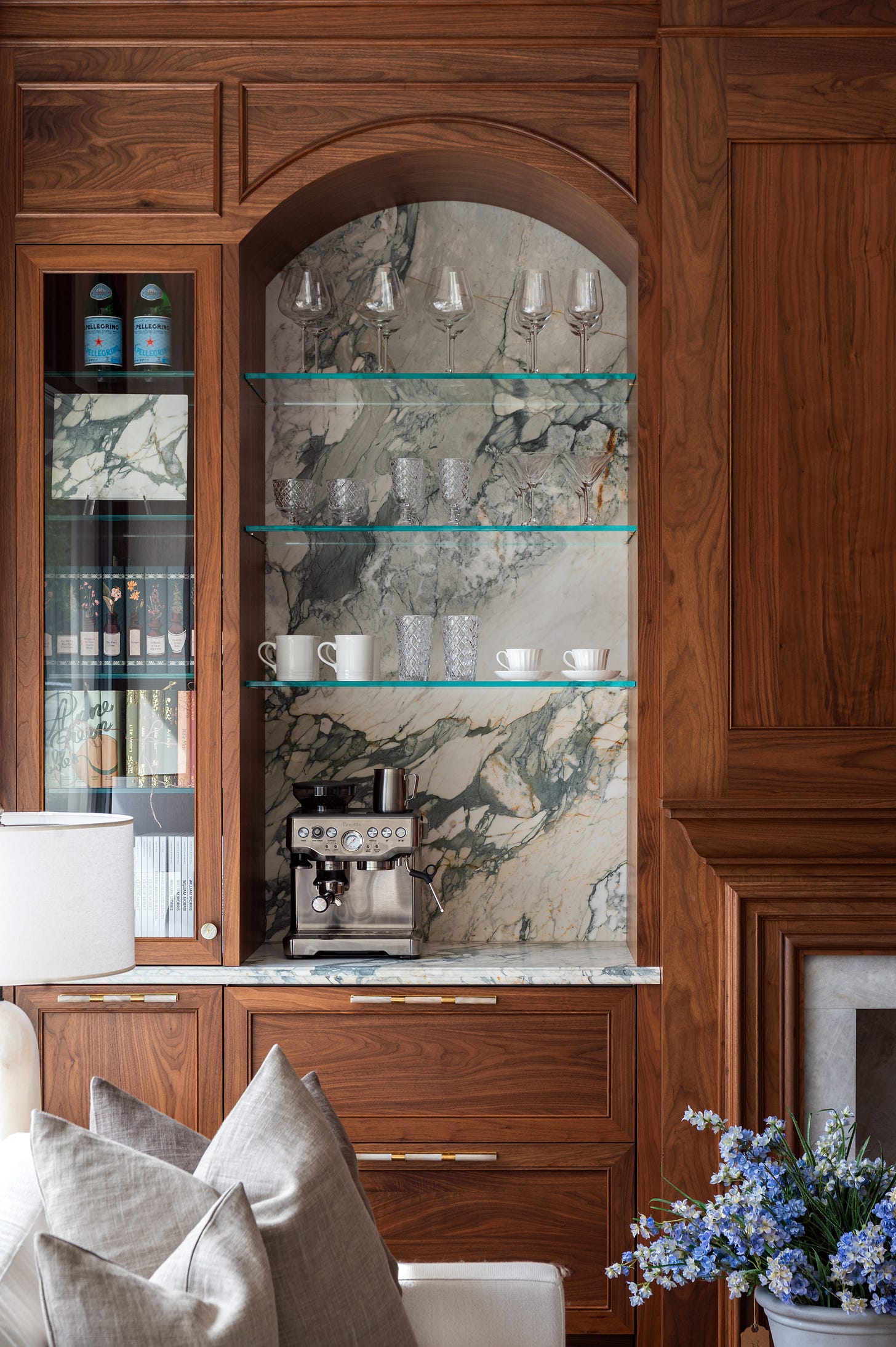
There is quite a lot going on in this little corner. And I’m here to share every detail with you.
Custom walnut cabinetry, a particularly beautiful piece of marble, refrigerated drawers hiding in plain sight, and some surprisingly inexpensive lighting.
I thought it would be fun to start sharing the actual specifications behind some of our finished spaces. Not just where we found things, but why we chose them, how they work together, and a few details worth knowing if you’re planning something similar.
1. Select Walnut Cabinetry
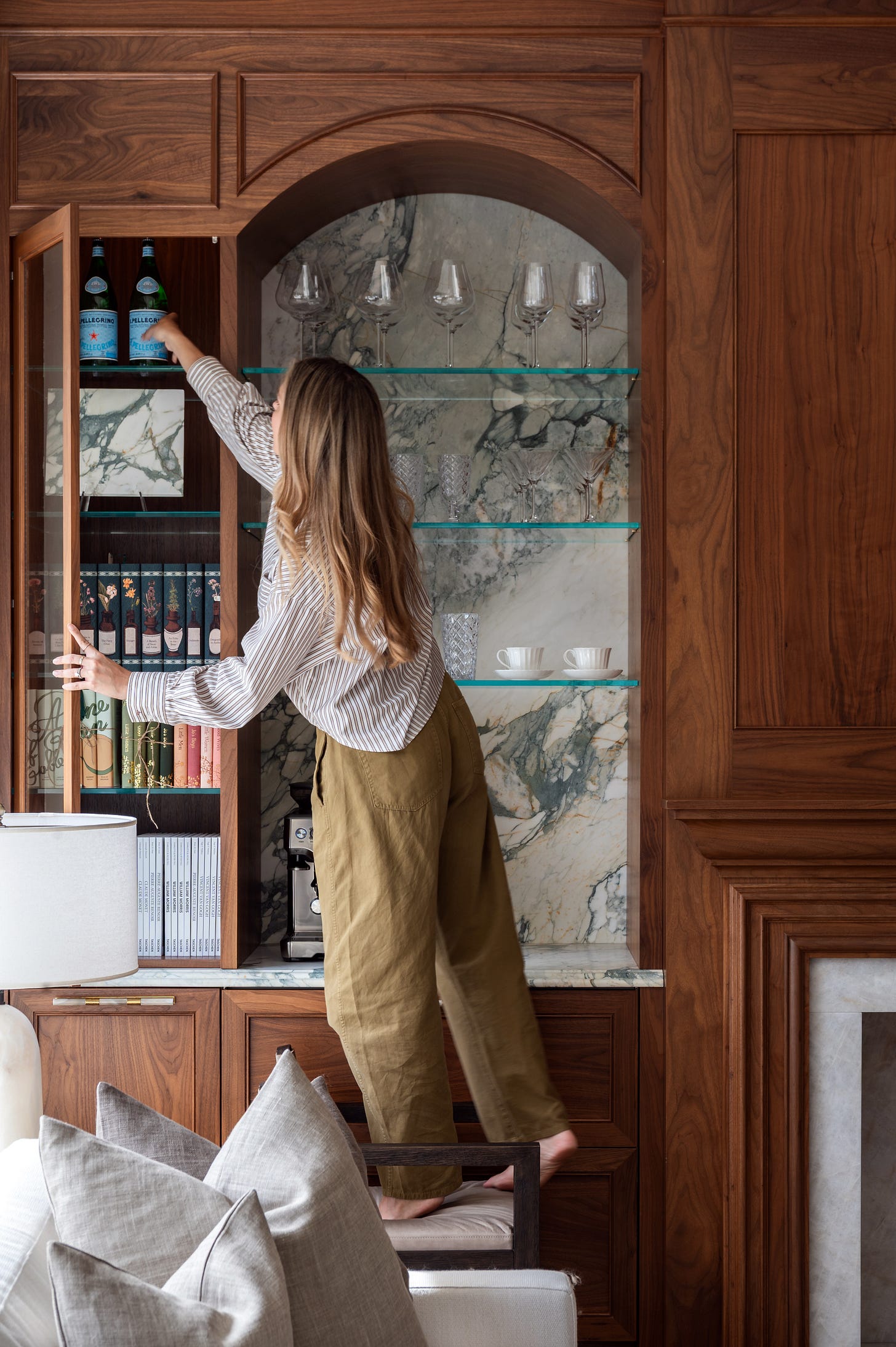
All of the cabinetry was hand-drawn by our design team and fabricated by Amish craftsmen.
We specified select walnut for its beautiful grain and natural warmth. Walnut has enough character to stand on its own, but it also happens to be a wonderful backdrop for a dramatic stone.
The arched opening, integrated refrigeration, and glass shelving were all designed together rather than treated as separate elements.
A little advice: If you’re investing in custom cabinetry, think about the entire composition before getting too attached to individual cabinet dimensions. The proportions, transitions, and architectural details are often what make the difference.
2. Calacatta Turquoise Antique Marble
This is Calacatta Turquoise Antique Honed marble from Calia Stone.
And yes, it’s every bit as beautiful in person.
The movement in this stone is extraordinary, with deep charcoal and green-gray veining running through a warm white background.
We used it on both the countertop and the back wall, which gives the entire opening a sense of continuity.
The antique-honed finish is particularly lovely. Rather than a highly reflective polished surface, it has a softer appearance that feels right at home alongside the walnut.
A little advice: When you’re choosing a heavily veined natural stone, look at the actual slabs. A small sample will tell you something about the color, but very little about the movement. And the movement is often the whole point.
See the exact marble at Calia Stone
3. The Ogee Bullnose Stack
This is one of those tiny details that can completely change how a countertop feels.
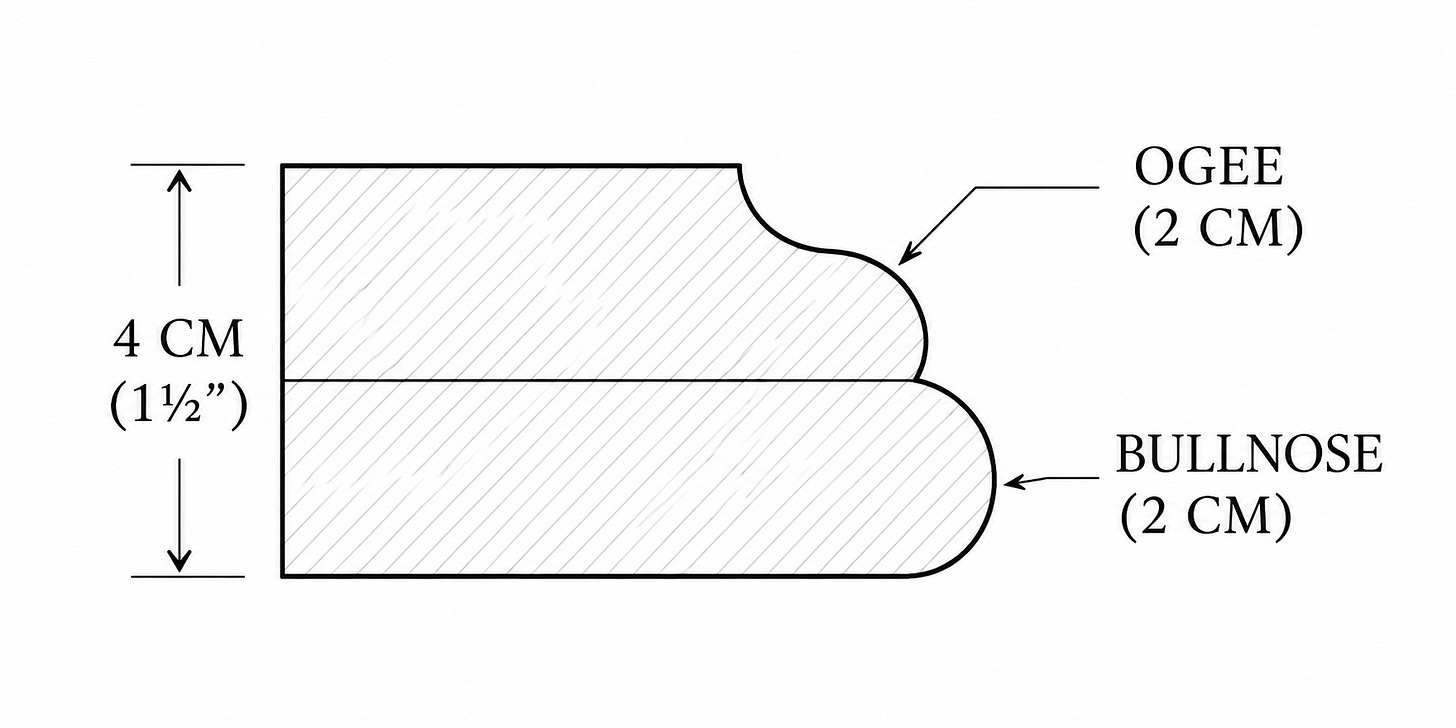
We specified an ogee bullnose stack, a traditional edge treatment that combines the decorative curve of an ogee with the softer rounded profile of a bullnose.
Our stone is 2cm thick, but we stacked two layers at the edge to create a 4cm (approximately 1½-inch) finished profile.
It’s a particularly beautiful detail on natural stone because it introduces shadow and dimension without requiring another material.
A little advice: Stone edge profiles deserve more attention than they usually receive. Ask your fabricator to show you a full-size sample or a dimensioned drawing before approving the profile. The exact curves and thickness make an enormous difference.
4. Low-Voltage Lighting
Possibly my favorite small investment in the entire bar.
We used recessed low-voltage LED puck lights, installed in the flat walnut panel at the top of the glass-front cabinet. They illuminate the contents without requiring a visible decorative fixture.
Here are the actual components from our specifications:
(Qty 2) GMLISP-2-27-BZ LED Puck, 2.2W, 170 lumens, 2700K $33.20
(Qty 1) GMLIPSD15-12 LED Slim Puck Driver, $42.36
Total $75.56
These are our original material costs, excluding installation and wiring. Current retail pricing may vary. Wiring, labor, and any additional components are separate.
A little advice: Plan your lighting before the cabinetry goes into fabrication. The wiring paths, driver location, and placement of the lights all need to be coordinated in advance.
It’s a relatively small detail that is much easier to get right before everything is installed.
5. Bosco Hardware
The hardware is from Bosco London, in light horn with polished brass.
I love the combination of natural horn and brass against the walnut.
There’s enough contrast to appreciate the hardware, but it doesn’t compete with the movement in the marble.
A little advice: Hardware is one of the last things people tend to select, but it can have an outsized impact on the finished cabinetry. Whenever possible, look at the actual finish and material against your cabinet sample rather than selecting from a photograph.
Explore Bosco London’s hardware
6. 36-Inch Sub-Zero Refrigerator Drawers
The refrigeration is tucked into the cabinetry with 36-inch panel-ready Sub-Zero refrigerator drawers.
I love refrigerated drawers in entertaining spaces because they keep everything accessible without introducing another visible appliance.
And because these are panel-ready, the cabinetry can continue uninterrupted across the front.
A little advice: Decide on your appliances before finalizing cabinetry drawings. Panel-ready does not mean one-size-fits-all. The appliance specifications determine the opening, panel requirements, clearances, and ventilation details.
See the Sub-Zero refrigerator drawers
What Makes This Room Work
I think the most interesting thing about this bar is that no single detail is responsible for making it beautiful.
The walnut brings warmth. The marble brings movement. The glass shelves allow the stone to remain visible. The lighting gives the cabinetry a little life. And the refrigeration is there when you need it, without becoming the focal point.
But all of those things had to be considered together.
That’s really what good design comes down to. Not necessarily choosing the most expensive version of everything, but understanding how the individual decisions affect one another.
And occasionally, a $16.60 puck light can make a pretty compelling contribution.
More rooms, materials, and actual project specifications to come. Subscribe and follow for more.